
Introduction: Understanding the Worry behind the Words
Watching your toddler grow and start speaking is one of the most anticipated joys of parenting. From babbling to that precious first “mama” or “dada,” every word feels like a milestone. But what if your child seems to be speaking less than other children their age? What if the words just aren’t coming yet?
It’s natural for parents to feel anxious when a child doesn’t meet typical speech milestones. However, speech delays are more common than most parents realize, and recognizing the early signs can make a significant difference in a child’s development. At Shaping Insight, Mulund, we work closely with families to identify, assess, and address speech delays through compassionate, evidence-based intervention.
This blog provides a comprehensive guide to understanding signs of speech delay in toddlers, when to seek help, and how early intervention can support your child’s communication journey.
What is a Speech Delay?
A speech delay means a child is not meeting the expected timeline for developing speech and language skills. While every child develops at their own pace, there are general age-based milestones that give us a framework for typical development.
A speech delay may involve:
- Difficulty forming words or sounds
- Limited vocabulary for their age
- Trouble combining words into phrases
- Problems understanding language or following directions
It’s important to distinguish speech from language:
| Speech | Language |
| The verbal expression of language (sounds, words) | The broader system of communication (understanding and using words, gestures, grammar) |
| Includes articulation, voice, fluency | Includes receptive (understanding) and expressive (speaking) skills |
A toddler may have a speech delay (difficulty forming sounds or speaking clearly) or a language delay (trouble understanding or using words meaningfully), or both.
Key Speech and Language Milestones in Toddlers
Here is a general timeline of what to expect and when. If a child significantly lags behind these milestones, it may be time to consult a professional.
| Age | Expected Speech and Language Skills |
| 12 months | Babbles, says “mama/dada”, gestures (waves, points), responds to name |
| 18 months | Says ~10–20 words, uses basic nouns and familiar names |
| 24 months | Uses ~50+ words, begins two-word phrases (“more juice”), points to familiar objects |
| 30 months | Uses short sentences (~3–4 words), follows simple instructions |
| 36 months | Has a vocabulary of 200–1,000 words, speaks in full sentences, can be understood 75% of the time by strangers |
Note: Missing one or two of these may not be cause for concern — but consistent delays across categories should prompt evaluation.
Everyday Clues That May Signal a Speech Delay
Speech delays don’t always show up as “missed milestones.” Often, they present in subtle ways during day-to-day interactions. Parents may not realize that behaviours they chalk up to personality traits or shyness can actually be signs of delayed speech or language development.
Here’s what to watch for in real-world situations:
→ Unusual Frustration or Tantrums During Basic Requests: If your toddler frequently becomes upset when trying to ask for something simple (like food, toys, or attention), it may be because they know what they want but struggle to express it, leading to communication-based meltdowns.
→ Over-Reliance on Gestures or Pulling Your Hand: Children who consistently point, pull adults toward items, or use facial expressions instead of trying to vocalize their needs may be compensating for limited verbal skills.
→ Using the Same Few Sounds or Words for Everything: Instead of expanding vocabulary, some toddlers will use one word (“this”) or one sound (“uh”) for multiple meanings. This could indicate difficulty forming new sounds or learning word associations.
→ Lack of Curiosity About Words or Names
Most toddlers naturally start labeling things and asking “what’s this?” by around age two. If your child seems disinterested in naming or repeating new words, that could be a red flag.
→ Echoing Instead of Expressing: If your child tends to repeat exactly what you say (“Do you want water?” → “Want water?”) instead of forming their own responses, this might indicate echolalia, a common pattern in speech or language delays and in neurodiverse children.
→ Disconnection Between Play and Language: Toddlers typically narrate play in some way, even nonverbally. If your child engages in play silently, or doesn’t use sounds to describe, pretend, or invite interaction, that might signal limited expressive language.
→ Preferring Screens Over People: If your toddler prefers watching TV or playing on a phone and seems disinterested in people-based interaction, this could be a sign of delayed social-communication development, often linked to speech concerns.
Why These Clues Matter More Than Milestones
Many children don’t hit every milestone exactly on time and that’s okay. But when a pattern of avoidance, substitution, or frustration becomes frequent, it’s important to look deeper. These subtle signs provide early opportunities to intervene before frustration or behavioral issues escalate.
At Shaping Insight, Mulund, we help families decode these everyday moments. Our goal isn’t to compare your child to a chart, it’s to understand how they communicate, what’s getting in the way, and how we can support their unique voice.
Potential Causes of Speech Delays
Speech delay can have a range of causes. Understanding the root can guide effective therapy.
| Cause | Description |
| Hearing loss | Even mild hearing issues can impact sound and word learning |
| Oral-motor problems | Weakness or poor coordination of mouth muscles |
| Developmental disorders | Autism Spectrum Disorder, intellectual disability, or global developmental delay |
| Environmental factors | Limited verbal interaction, lack of exposure to language, excessive screen time |
| Neurological conditions | Cerebral palsy, epilepsy, or other conditions affecting brain development |
| Bilingual environment | Can cause temporary delays in speech output, though this is usually not a concern |
When to Seek Help
Early intervention leads to better outcomes. You should consult a speech-language therapist if:
→ Your child isn’t meeting basic speech milestones
→ You are often asked to “translate” what your child says
→ There’s frustration or behavioral issues linked to communication
→ Your child shows signs of other developmental delays
→ You’re simply concerned your instinct as a parent is valid
At Shaping Insight, Mulund, we offer comprehensive speech and language evaluations for toddlers. Our assessments consider developmental history, sound production, understanding and use of language, play, social interaction, and parent feedback.
How Speech Therapy Helps Toddlers with Delays
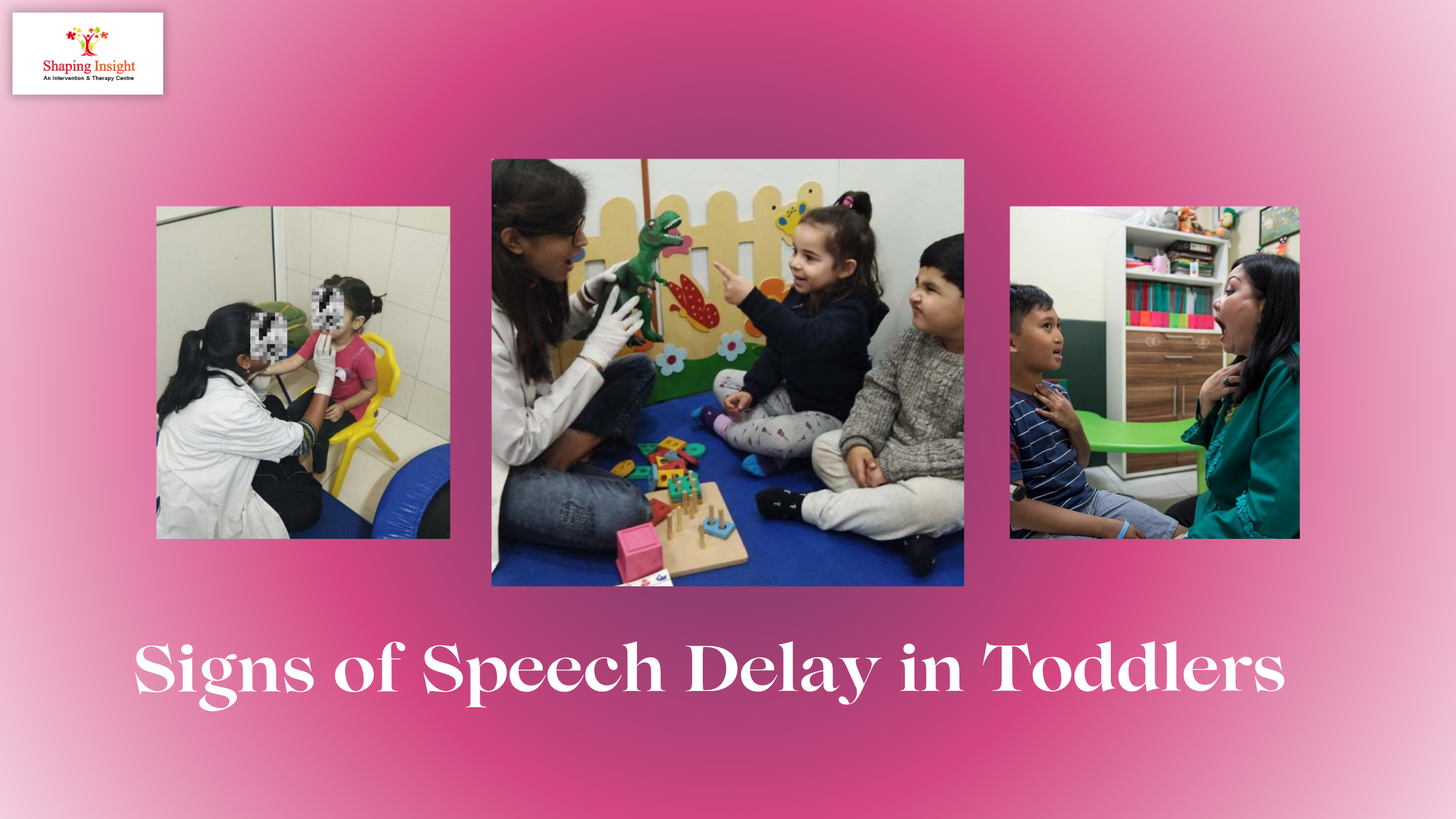
Speech therapy is not just about talking; it’s about building communication pathways. At our center in Mulund, our certified speech therapists design individualized plans that help children improve both expressive and receptive language skills through play-based and evidence-based techniques.
Our approach includes:
→ Articulation therapy for sound clarity
→ Language development activities using toys, pictures, and everyday interactions
→ Parent coaching for consistency at home
→ Integration of sensory-friendly strategies for children with autism or sensory needs
We believe in early, fun, and functional therapy, helping children speak, understand, and connect with the world around them.
What Makes Shaping Insight, Mulund, Different
At Shaping Insight, Mulund, we are more than just a therapy center — we’re a team of qualified speech therapists, occupational therapists, and behavioral specialists who collaborate to provide holistic care for each child.
→ We tailor every therapy plan to your child’s learning style and developmental pace
→ Our center offers a nurturing, child-friendly environment that encourages natural communication
→ We work closely with families, guiding parents on how to support speech development at home
→ Our speech therapy is often combined with occupational therapy for children with oral-motor, sensory, or behavioral needs
→ We also provide ABA therapy where behavioral factors are linked to communication delays
Tips to Encourage Speech at Home
Parents play a vital role in promoting speech development. Here are some things you can try at home:
→ Talk to your child throughout the day describe what you’re doing
→ Use simple, clear language and repeat key words
→ Sing songs, recite rhymes, and read books daily
→ Give your child choices to encourage verbal responses (e.g., “Do you want milk or juice?”)
→ Limit screen time and increase face-to-face interaction
→ Pause during conversations to encourage your child to fill in the blank
Conclusion:
Recognizing the signs of speech delay in toddlers is the first step toward meaningful change. At Shaping Insight, Mulund, we are committed to helping children find their voice — at their pace, on their terms. If you have concerns, don’t wait. Early support can open doors to connection, confidence, and future success.
📍 Visit our center in Mulund to schedule a speech evaluation
🌐 Visit our website: https://www.shapinginsight.com/
📞 Call us at: +91 9769376766
📧 Email us at: info@blog.shapinginsight.com Let’s give your child the tools to communicate, connect, and shine.