

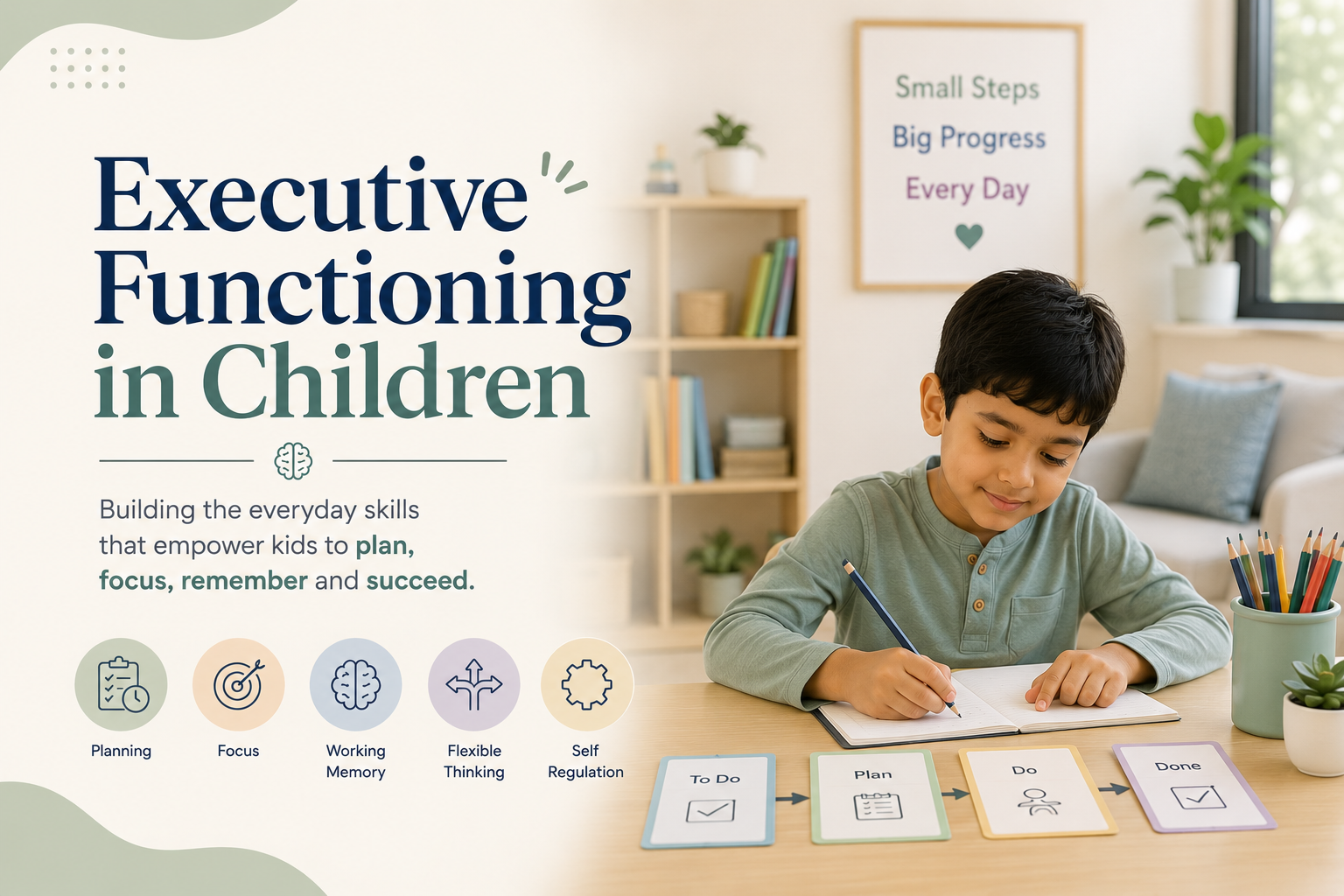
Why does your child forget where they kept their school supplies, struggle to start homework, lose track of instructions, or need constant reminders to complete simple routines? These behaviours can sometimes be connected to Executive Functioning in Children. Executive functions are the mental skills that help us plan, organize, remember information, control impulses, manage time, shift between activities, and complete tasks.
Children are still developing these abilities, so occasional forgetfulness and disorganization are completely normal. However, when difficulties consistently interfere with schoolwork, routines, relationships, or independence, understanding executive functioning can help parents provide more effective support.
What Are Executive Functions?
Think of executive functions as the brain’s management system.
They help children decide:
What do I need to do?
What should I do first?
What do I need to remember?
How do I stay focused until the task is finished?
Important executive functioning skills include:
- Working memory
- Planning
- Organization
- Attention
- Impulse control
- Time management
- Flexible thinking
- Task initiation
- Emotional regulation
These skills develop gradually throughout childhood and adolescence.
A young child is not expected to manage these abilities independently. Adults naturally provide reminders and structure. As children grow, however, they gradually learn to take more responsibility for their own routines.
What Can Executive Functioning Difficulties Look Like?
Parents may notice that their child:
- Frequently forgets instructions
- Loses school materials
- Has difficulty starting homework
- Leaves tasks unfinished
- Needs repeated reminders
- Struggles to organize belongings
- Becomes overwhelmed by multi-step activities
- Finds transitions difficult
- Has trouble managing frustration
- Starts several activities without completing them
A child displaying these behaviours is not necessarily lazy or careless.
Sometimes the child genuinely wants to complete the task but does not yet have the skills needed to organize the steps independently.
This distinction is important.
Instead of saying, “You never pay attention,” parents can ask, “What part of this task is difficult for you?”
Executive Functions and School
School places significant demands on executive functioning.
Children are expected to:
- Listen to instructions
- Remember homework
- Organize notebooks
- Complete assignments
- Manage classroom materials
- Switch between subjects
- Follow routines
- Meet deadlines
For children who struggle with executive functioning, these expectations can feel overwhelming.
A child may understand the academic concept perfectly but still struggle to complete the assignment because they cannot organize the steps required.
This is why academic performance should always be viewed alongside the child’s broader skills.
How Occupational Therapy Can Help
At Shaping Insight, Mulund, Occupational Therapy can support children in developing the underlying skills required for greater independence.
Therapy may focus on:
- Attention and concentration
- Planning
- Sequencing
- Organization
- Working memory
- Motor planning
- Emotional regulation
- Task completion
Therapists can break activities into manageable steps and gradually help children become more independent.
For example, instead of expecting a child to independently prepare their school bag, a therapist may first teach a simple sequence:
Check timetable → collect books → pack homework → add stationery → zip bag.
With repetition and appropriate support, the child can gradually learn to complete the sequence more independently.
Simple Strategies for Parents
Parents can make everyday routines easier by reducing the amount of information presented at once.
Instead of saying:
“Get ready, put your books away, wear your shoes, pack your lunch, and come downstairs.”
Try breaking it into smaller steps.
“First, put your books in the bag.”
Once that is completed:
“Now put on your shoes.”
Visual reminders can also be extremely useful. A morning checklist with simple pictures or words can help children remember what needs to happen without relying entirely on verbal reminders.
Other helpful strategies include:
- Keeping belongings in consistent places
- Using simple routines
- Preparing school items the night before
- Using timers for transitions
- Breaking large assignments into smaller tasks
- Praising completed steps
- Allowing children to solve problems before immediately helping
The goal is not to remove every challenge. It is to give children enough structure to gradually develop independence.
Emotional Regulation and Executive Functioning
Executive functioning and emotional regulation are closely connected.
When children are tired, hungry, overwhelmed, or frustrated, their ability to plan and control impulses may become more difficult.
A child who normally completes homework independently may struggle after a particularly demanding school day.
This is why supporting sleep, movement, predictable routines, and opportunities for breaks can be valuable alongside skill-building.
At Shaping Insight, Mulund, therapy focuses on the child as a whole rather than looking at one behaviour in isolation. Occupational Therapy can help children develop practical strategies for managing everyday demands, while appropriate multidisciplinary support can address communication, sensory, and developmental needs when required.
Executive functioning skills continue developing over many years. A child does not need to master everything immediately.
With consistent support, clear routines, and opportunities to practise, children can gradually become better at planning, organizing, managing emotions, completing tasks, and taking responsibility for everyday activities.
The goal is not simply a more organized school bag. It is helping children develop the skills they need to become increasingly independent, confident, and capable.