

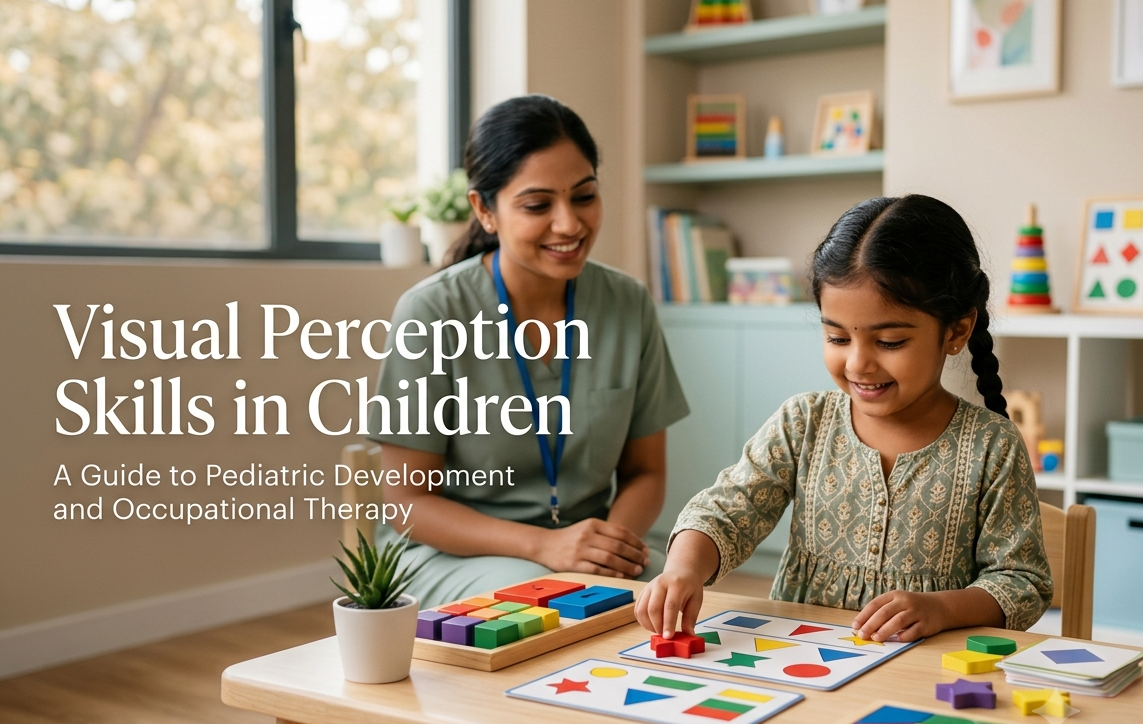
Many parents assume that if their child has perfect eyesight, they won’t have any vision-related challenges. However, a child can see clearly and still struggle to understand and interpret what they see. This is where Visual Perception Skills in Children become important.
Visual perception is the brain’s ability to make sense of visual information. It helps children recognize letters, identify shapes, copy from the board, solve puzzles, judge distances, and complete everyday tasks with confidence. These skills are essential for learning, handwriting, reading, mathematics, and even sports.
When visual perception skills are underdeveloped, children may appear careless, easily distracted, or slow to complete schoolwork. In reality, they may simply be finding it difficult to process visual information efficiently.
What Are Visual Perception Skills?
Visual perception is more than eyesight. While eyesight allows children to see objects clearly, visual perception helps the brain understand what those objects are and how they relate to one another.
Children use visual perception every day when they:
- Read books
- Copy notes from the classroom board
- Complete puzzles
- Match shapes and colours
- Recognize letters and numbers
- Find objects in a busy room
- Build with blocks
- Catch and throw a ball
- Draw pictures
- Solve maths worksheets
These abilities develop gradually as children grow and gain new experiences.
Signs Your Child May Have Difficulty with Visual Perception
Every child learns differently, but certain signs may indicate challenges with visual perception.
Your child may:
- Reverse letters or numbers while writing
- Lose their place while reading
- Have messy or uneven handwriting
- Struggle to copy from the board
- Take longer to complete worksheets
- Frequently bump into objects
- Find puzzles difficult
- Have trouble identifying similarities and differences
- Misjudge distances while catching a ball
- Become frustrated with drawing or colouring activities
These challenges are often mistaken for poor attention or lack of effort, when they may actually be linked to visual processing.
Why Are Visual Perception Skills Important?
Strong visual perception skills support many areas of a child’s development.
They help children:
- Read more accurately
- Improve handwriting
- Organize work neatly
- Understand patterns in mathematics
- Develop problem-solving skills
- Build confidence in the classroom
- Participate in sports and play
- Complete daily activities independently
When these skills improve, children often become more confident learners and experience less frustration during school activities.
What Can Affect Visual Perception?
Several factors can influence how children process visual information.
Delayed Development
Some children simply require additional time and practice to strengthen visual processing skills.
Developmental Conditions
Children with Autism Spectrum Disorder (ASD), ADHD, Developmental Coordination Disorder (DCD), or learning difficulties may experience challenges with visual perception.
Limited Opportunities for Practice
Hands-on play such as puzzles, building blocks, drawing, and crafts naturally develops visual perception. Children who spend most of their free time on screens may have fewer opportunities to strengthen these skills.
Difficulty Integrating Information
Sometimes the eyes see information correctly, but the brain needs support to organize and interpret it effectively.
How Occupational Therapy Can Help
At Shaping Insight, Mulund, Occupational Therapy focuses on strengthening the underlying skills children need for successful learning and everyday participation.
Rather than only practising handwriting or worksheets, therapists work on improving the foundation skills that support visual learning.
Therapy may include activities to improve:
- Visual discrimination
- Visual memory
- Spatial awareness
- Hand-eye coordination
- Eye tracking
- Figure-ground perception
- Visual sequencing
- Bilateral coordination
Sessions are designed around play, making learning enjoyable while building important developmental skills.
Activities Parents Can Try at Home
Parents can support visual perception through fun and engaging activities.
Some simple ideas include:
- Completing jigsaw puzzles
- Playing “spot the difference” games
- Building with LEGO or blocks
- Matching picture cards
- Mazes and dot-to-dot activities
- Sorting objects by size or colour
- Treasure hunts around the house
- Copying simple patterns with blocks
- Drawing and colouring
- Memory card games
These activities encourage children to observe, compare, organize, and interpret visual information in enjoyable ways.
When Should Parents Seek Professional Support?
It may be beneficial to consult an Occupational Therapist if your child:
- Continues reversing letters beyond the expected age
- Avoids reading or writing tasks
- Has persistent difficulty copying from the board
- Frequently loses their place while reading
- Struggles with puzzles or pattern recognition
- Finds schoolwork visually overwhelming
- Has difficulty with hand-eye coordination during play
Early support can prevent these challenges from affecting academic confidence and participation.
Helping Children See, Understand and Succeed
Visual perception is one of the many hidden skills that support a child’s success at home and in school. When children can accurately understand and organize visual information, everyday tasks become easier, learning becomes more enjoyable, and confidence naturally grows.
At Shaping Insight, Mulund, our Occupational Therapists create individualized therapy programs that strengthen visual perception through engaging, evidence-based activities tailored to each child’s needs. By developing these essential skills early, children are better prepared to succeed in academics, sports, play, and everyday life.
Every child has the potential to thrive with the right guidance, encouragement, and support.